I am a CNRS research fellow in the Synaptic Transmission Physiopathology team at the Institute of Functional Genomics (Montpellier).
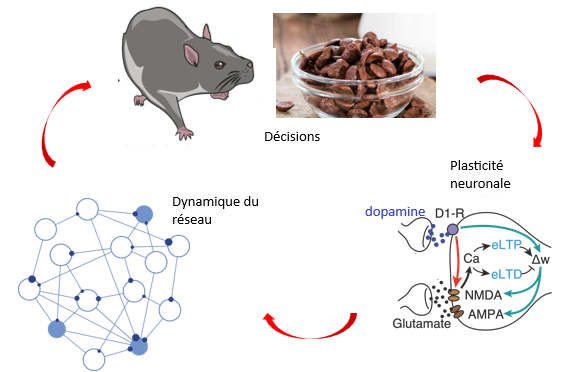
How do decisions emerge from molecular interactions within neurons and synapses? This fundamental question remains unresolved, as it requires bridging a theoretical and methodological gap between three levels of organization: intracellular signaling pathways, the electrical dynamics of neural networks, and cognitive functions. Current approaches specialize in a single level: molecular neuroscience studies signaling in vitro, systems neuroscience records neural activity during behavior, and computational neuroscience models decisions using abstract algorithms. Each level of organization is approached with its own tools, vocabulary, and theories, making integration difficult. In my work, I have developed dynamic and computational theories based on assemblies of neurons. These assemblies are constructed through synaptic plasticity and dynamically modulated. This framework provides a common language for linking the molecular, network, and cognitive levels.
Our approach is characterized by three key aspects:
- Methodological integration: we combine modeling, in vivo experiments, and quantitative behavioral analysis. This versatility allows us to design projects in which modeling guides the experiments and data constrain the models.
- Multi-scale approach: Unlike “bottom-up” (starting from molecules) or “top-down” (starting from behavior) approaches, we work simultaneously at all three levels, using constraints from each level to inform the others.
- Testable theories: Our models generate quantitative and qualitative predictions about the effects of perturbations on biological substrates, which are then tested experimentally.
Projects
Cognitive Flexibility, FRM Team Animals must learn quickly when their environment changes, but slow down their learning rate when the consequences of their actions provide little information. Our goal is to assess how this adaptive learning arises from the trade-off between synaptic plasticity and stability, from the molecular level to the level of neural networks. We combine behavioral recordings and manipulations in mice with modeling at the synaptic and network levels.
The team has been awarded by the French Medical Research Foundation (Fondation pour la Recherche Médicale) for this project.
Neural Bases of Timing, ANR TimeTag Deciding when to act is as important as deciding what to do. Cortical neurons fire just before well-timed decisions are made. How does such precise activity emerge? Is this activity a cause or a consequence of synchronization? We use selective and reversible inactivation of neural ensembles (using inducible c-fos technology) during the production of a timed behavior to compare and select competing models.
ANR funding in collaboration with Bruno Delord (Paris) and Stéphanie Trouche (Montpellier).
Social Decision-Making, MITI 80PRIME CNRS Joint decisions incorporate expectations regarding the other person’s decisions. We still need to discover how others’ rewards and efforts are represented in the brain, and how they causally influence behavior. To find out, we are developing a new social task in mice (a kind of collaborative two-player game) and theoretical models of joint decision-making.
80PRIME funding with Marwen Belkaid (Cergy U.)
Molecular Dynamics Related to Learning, ANR LEARN The molecular signaling involved in synaptic plasticity includes early messengers that converge on integrative protein kinases. These pathways interact dynamically during learning and may or may not trigger synaptic plasticity in neural networks. We study these dynamics using biosensors via in vitro and in vivo microscopy, which we compare with mathematical models of molecular dynamics.
ANR funding with the team (Julie Perroy, Pierre Vincent, Vivien Szabo, Enora Moutin, Nathalie Bouquier, Cathie Ventalon).
Surpervision
- Asma Fadil · PhD since 2025 · Timing Project · co-supervised by B. Delord (Paris)
- Elodie Valero Master’s internship (2026) · Timing Project · co-supervised by S. Trouche (Montpellier)
- Emma Debos · Ph.D. since 2024 · Timing Project · co-supervised by S. Trouche (Montpellier)
- Juan Cobos · Ph.D. since 2024 · Social Project · co-supervised by M. Belkaid (Cergy U.)
- Coline Chevallier · Ph.D. since 2023 · Flexibility Project
Collaborations
- Jyotika Bahuguna, Strasbourg.
- Antoine Besnard, Montpellier.
- Eric Burguière, Lyon.
- Fabien Campillo, Montpellier.
- Etienne Coutureau, Bordeaux.
- Laurent Givalois, Montpellier
- Philippe Faure, Paris.
- Emmanuel Périsse, Montpellier.
- Emmanuel Procyk, Lyon.
Alumni
- Mathieu Sarazin · PhD defended in 2022 - co-supervised by Bruno Delord · currently a data scientist
- Elise Bousseyrol PhD defended in 2022 - co-supervised by Philippe Faure · currently a science communicator